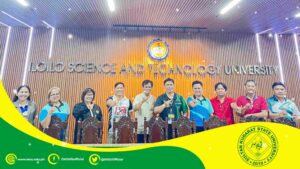
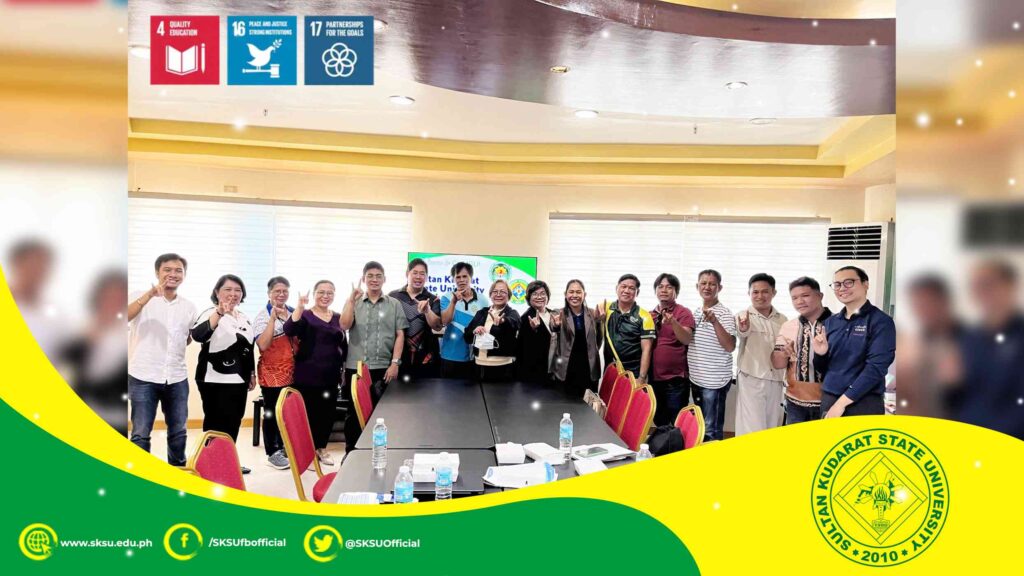

TALISAY CITY, Negros Occidental — Carlos Hilado Memorial State University (CHMSU) highlighted its green governance, digital transformation initiatives, and faculty benefits during a session with the Sultan Kudarat State University Faculty Association, Inc. (SKSU-FAI) on October 1, 2026, at the Business Center Administration Building in Talisay City.
The benchmarking visit included a courtesy call on University President Norberto P. Mangulabnan, PhD, alongside Engr. Manuel A. Uy, PhD, president of the CHMSU Faculty Alliance and faculty representative to the CHMSU Board of Regents.
The SKSU-FAI delegation was represented by President Eulogio O. Apellido Jr., Treasure -Dr. Rosita T. Rizaldo, Business Manager-Evora H. Dioneza, Committee Chair on Faculty Welfare and Development – Prof. Leonard Ibot, and Campus Faculty Association Presidents Christine Abo (ACCESS), Hessan Talapas (Palimbang), Cresencio Antonio (Bagumbayan), Donald Cogo (Kalamansig), and Samuel Salvador (Lutayan).
CHMSU was represented during the benchmarking exchange by:
Engr. Russel M. Dela Torre, Officer-in-Charge, Vice President for Administration and Finance
Dr. Noralyn S. Esona, Assistant Vice President for Academic Affairs
Engr. Manuel A. Uy, PhD, Faculty Representative to the Board of Regents and President of the CHMSU Faculty Alliance
Dr. Liezl May C. Tortogo, Director for Curriculum and Instructional Material Development
Ariane M. Torres, Head of Information and Communications Technology (ICT)
Engr. John Kevin B. Moraca, Head of the Management Information System (MIS) and Data Protection Office
Paz Marie Somcio, Secretary of the CHMSU Faculty Alliance
Keith Brandon Cari-an, Information Officer
Information Officer Keith Brandon Cari-an opened the session around three primary themes: green governance, the digital university framework, and Collective Negotiation Agreement (CNA) benefits.
CHMSU’s vision to become a leading green institution of higher learning by 2030 rests on its GREEN institutional pillars:
G – Good Governance
R – Research-Oriented
E – Extension-Driven
E – Education for Sustainable Development
N – Nation-Building
Officials emphasized that a culture of ecological stewardship is embedded throughout administrative and academic operations. On environmental sustainability and fiscal discipline, CHMSU outlined cost-saving measures in energy conservation, water management, and waste recycling. Faculty members actively support these efforts by serving as campus patrol personnel monitoring utility use. The university also enforces a strict zero-waste thrust and a “race to end waste” campaign. Under the Regional Operations and Support System (ROSS 2) structure, CHMSU positions its auxiliary service unit directly under the Office of Administration and Finance.
In instruction, CHMSU embeds Sustainable Development Goals (SDGs) into its academic programs through comprehensive SDG integration audits of course learning outcomes, teaching-learning activities, and assessment methods. Curricular documents undergo a rigorous two-phase review process involving the author, department dean, Curriculum Office, and Academic Affairs Office—first evaluating initial comments and suggestions, followed by a second verification check to confirm that all recommendations have been fully incorporated.
The session concluded with discussions on competitive faculty welfare provisions, including CNA monetary benefits, publication incentives, and institutional support for patent generation.