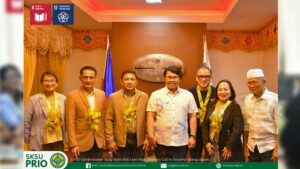
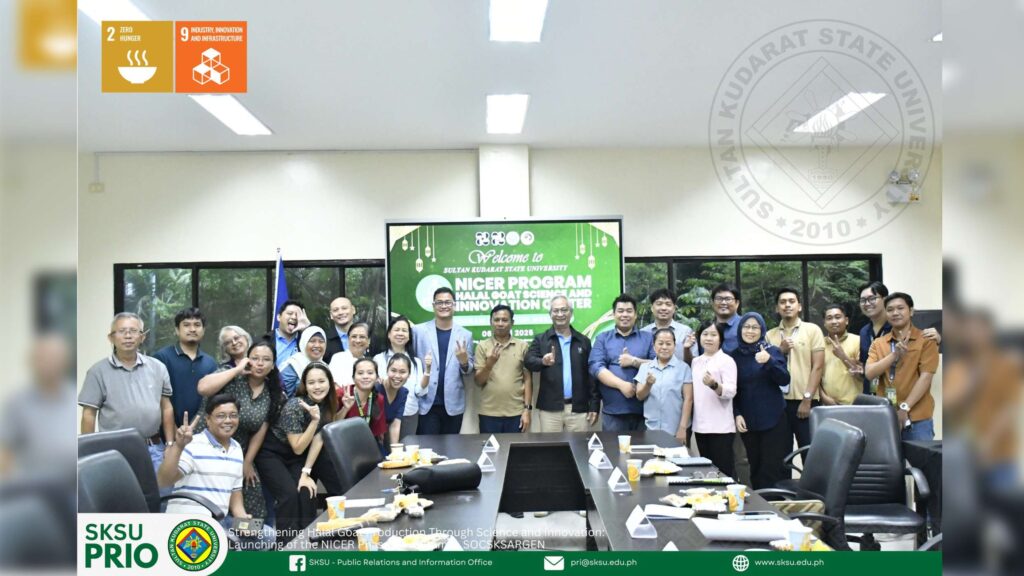

The NICER Halal Goat Science and Innovation Center Phase II was officially launched during its Inception Meeting held at Sultan Kudarat State University (SKSU) on June 25, 2025, drawing together stakeholders, researchers, and government partners committed to strengthening halal integrity and food security in the SOCSKSARGEN region.
Building on over a decade of research and development, the program reaffirms the region’s mission to produce chevon products that are not only halal (permissible) but also tayyib (pure and wholesome), in accordance with the Islamic principle of “halalan tayyiban.”
SKSU President Dr. Samson L. Molao welcomed guests, partners, and stakeholders, reminding the research community that, “Our work must go beyond academic output. This is about communities, livelihoods, and honoring the faith-based integrity of what we eat and how we produce it.”
Also delivering a message of support was Dr. Badu Panimbang, SKSU Vice President for Research, Extension, and Innovation, who reaffirmed the university’s full commitment to advancing halal science and community-based innovation. Several university staff members who play crucial roles in implementing the program’s four component projects were likewise in attendance, highlighting SKSU’s collective effort in leading this regionally significant initiative.
Fifteen years ago, the halal goat industry in Region XII was plagued by mislabeling and contamination issues. In response, the Department of Science and Technology funded the initial development of halal goat assurance protocols from 2010–2012, which later laid the groundwork for the Philippine National Standards (PNS BAFS 259:2018) on halal goat production.
The newly launched Phase II, in collaboration with DOST-PCAARRD, aims to scale and institutionalize these earlier gains through four strategic projects:
- Certification Guidelines for Halal Goat Farms
Led by Dr. Noraisa Yasin and Michael John Benavidez, this project develops formal certification criteria to assess the integrity of halal goat farms.
- Real-Time Data Analytics and Digital Traceability
Led by Joe Selayro and Kristine Mae Ampas, this initiative will automate the monitoring, forecasting, and traceability of goat production from farm to market.
- Halal Assurance System for Chevon-Based Products
Led by Cyril John A. Domingo, this project identifies potential contamination points from post-production to processing and establishes halal control systems for chevon-based dishes.
- Stakeholder Engagement and Strategic Communication
Led by Dr. Siony Brunio and Dr. Adonis Besa, this component scales out community-based training via the Farmer Livestock School (FLS-HGEM), School-on-the-Air, and online learning platforms to reach more farmers and aspiring halal entrepreneurs.
Dr. Synan S. Baguio, Director of DOST-PCAARRD’s Livestock Research Division, delivered the program rationale and challenged the researchers to ensure that halal goat production becomes not only a compliant industry but a sustainable and scalable enterprise. He was joined by agency representatives including Mr. Stephen Mendoza, Mr. Rundolfo P. Llamas, and Ms. Hannah Rheena Duldulao (via Zoom), along with partners from DOST Region XII, DA-ATI, and SOXAARRDEC, who shared valuable insights and pledged continued support for the program. Ms. Danica from the DOST OED–Research Division also provided a comprehensive presentation on the DOST-GIA guidelines, covering both financial and technical reporting requirements. She detailed the various forms and compliance documents necessary for smooth project implementation and monitoring, emphasizing accountability in fund utilization and results delivery. Also in attendance were Ms. Anna Marie P. Alo, retired Industry Strategic Program (ISP) Manager for Goat, and Dr. Ruby S. Hechanova, former Program Leader of the Halal Goat Program. Their presence underscored the legacy and foundational work that continues to shape the program’s current implementation.
The inception meeting also reflected on key accomplishments from Phase I, including the development of halal-compliant feed supplements (e.g., palm kernel cake-based rations), alternative training modalities during the pandemic, and TESDA-aligned competency courses in halal goat husbandry and slaughtering.
With seven halal goat farmers’ associations now organized and an accredited Double-A halal slaughterhouse operating at SKSU–Lutayan, the NICER Halal Goat Program Phase II aims to scale adoption, institutionalize halal certification mechanisms, and integrate producers into higher-value halal markets—all through the lens of halalan tayyiban.
This program represents a forward-looking model that unites religious values, scientific innovation, and inclusive development—ensuring safer, ethical, and faith-aligned food systems for communities across the region.