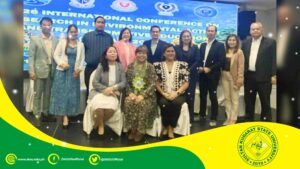
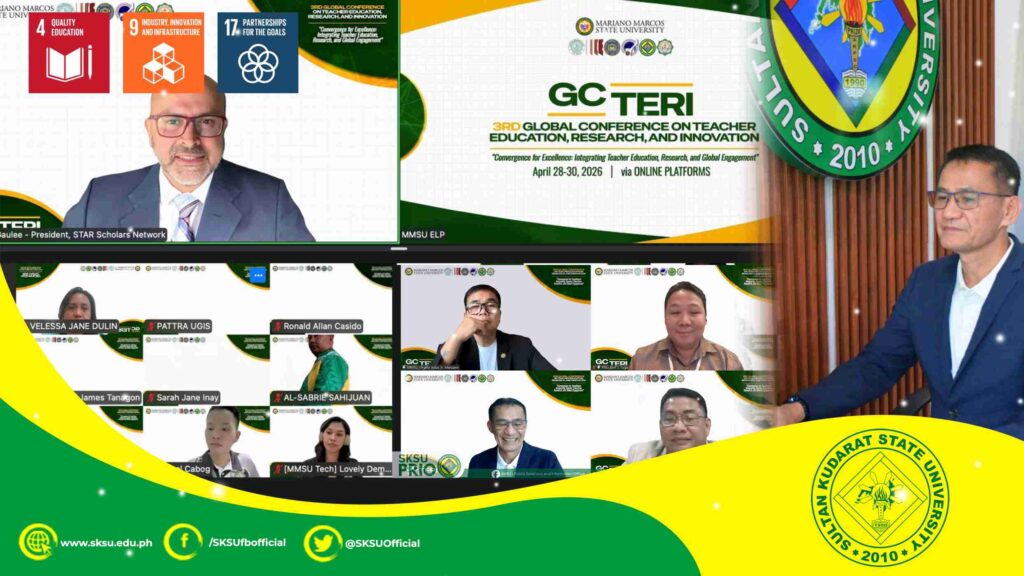

President Dr. Samson L. Molao represented Sultan Kudarat State University (SKSU) on the global stage as an esteemed panelist at the 3rd Global Conference on Teacher Education, Research, and Innovation (GCTERI). Hosted by Mariano Marcos State University (MMSU) from April 28 to 30, 2025, the conference brought together world-class educators to discuss the evolving landscape of higher education.
The panel featured a distinguished group of university presidents and chancellors, fostering a rich exchange of strategies between Philippine institutions and their international counterparts. Dr. Molao was joined by Dr. Virgilio Julius P. Manzano Jr., President of Mariano Marcos State University; Dr. Bert J. Tuga, President of the Philippine Normal University; Dr. Edgardo H. Rosales, SUC President of J.H. Cerilles State College; and Dr. Alfred Sife, Vice Chancellor of Moshi Co-operative University in Tanzania.
The discussion underscored the importance of cross-border collaboration and the integration of localized research into the global knowledge economy, areas in which SKSU continues to make significant strides under Dr. Molao’s leadership.
Panelists also examined the foundational architecture of modern academia, describing a strong innovation ecosystem as the synergy of multidisciplinary research, robust intellectual property frameworks, and “living laboratories” where theory meets practice. The consensus was clear. For higher education institutions (HEIs) to achieve global impact, they must evolve from being mere repositories of knowledge into active catalysts for economic and social transformation.
Offering a localized yet forward-looking perspective, Dr. Molao emphasized that regional universities serve as primary drivers of rural development.
In the final segment, panelists were asked to identify the single most strategic priority universities should pursue over the next five years. Dr. Molao presented a compelling vision that shifted the focus from institutional metrics to human impact, advocating for a deeply embedded culture of innovation. He argued that for innovation to be sustainable, it must move beyond being a “project” tied to promotion points or honoraria and instead become a shared mission, led, owned, and genuinely embraced by the entire academic community.
“Innovation is not defined by how many technologies we use or how many papers we publish,” Dr. Molao remarked. “Its true measure lies in the lives that are changed because we chose to act.”
Reflecting on the mission of Sultan Kudarat State University, he noted that the most powerful breakthroughs are often not the most complex, but the most accessible, those that reach farmers in the fields, fishers on the water, and entrepreneurs in the marketplace. Under his leadership, the university’s mandate for the next half-decade is clear. It is a decisive shift from knowledge generation to knowledge transformation. By moving from innovation for recognition toward innovation for inclusion, SKSU aims to demonstrate that the ultimate goal of higher education is not only academic excellence, but also meaningful societal impact that secures the future of the next generation.
 : Kier John F. Senerez