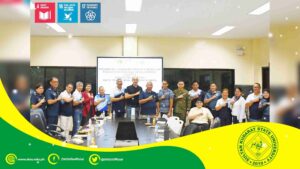
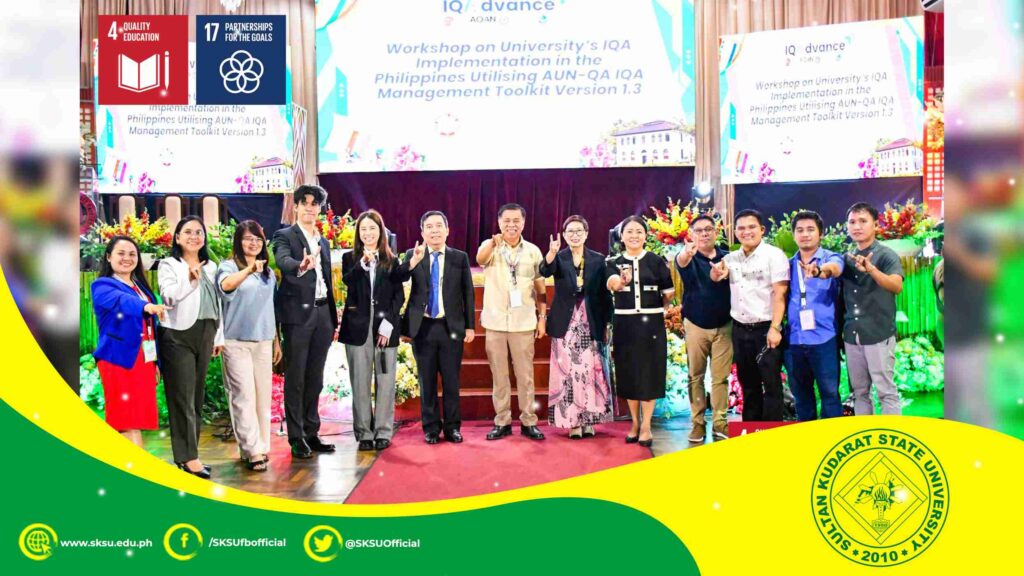

ZAMBOANGA CITY — The three-day regional workshop on Internal Quality Assurance (IQA) implementation continued with its second day on September 16 at the Western Mindanao State University (WMSU) Gymnasium, bringing together quality assurance leaders and university administrators to strengthen sustainable internal quality management systems across higher education institutions in Southeast Asia.
The workshop, IQA Advance, centers on the use of the AUN-QA IQA Management Toolkit Version 1.3, which provides a framework for institutions to develop quality assurance systems that go beyond procedural compliance and contribute to long-term institutional development.
Day 2 opened with a continuation of the toolkit’s core structural components, beginning with Building Blocks 3 and 4. Asst. Prof. Dr. Ornlatcha Sivarak of Mahidol University discussed Vertical and Horizontal Alignment, focusing on the importance of strategic alignment across different levels and functions within an institution.
Dr. Nguyen Huy Phuc of the Industrial University of Ho Chi Minh City followed with Integration and Simplification, highlighting approaches to make IQA processes more manageable and avoid unnecessary duplication. The morning sessions continued with Staffing and Capacity Building and Incentives and Recognition, both presented by Assoc. Prof. Dr. Dawisa Sritanyarat of the AUN Secretariat, emphasizing staff expertise, defined quality assurance roles, and recognition of continuous improvement efforts.
Sivarak then presented Leadership-driven QA Culture, underscoring the role of institutional leadership in embedding quality assurance into organizational practices. Phuc concluded the building block presentations with Data and Rankings, discussing the use of institutional data and performance indicators in supporting quality improvement and regional benchmarking.
In the afternoon, Sritanyarat led an executive presentation on operationalizing the toolkit, providing participants with practical approaches for applying its principles across different academic and institutional settings.
The sessions then shifted toward collaborative learning through Working Session 2 and Mini-Activity 3, where delegates worked in groups to translate the toolkit’s building blocks into actionable institutional frameworks. A moderated peer-learning discussion facilitated by Sritanyarat also provided participants an opportunity to exchange experiences, identify common systemic challenges, and share practices in implementing internal quality assurance across their respective institutions.
By the end of Day 2, participants had worked through all eight building blocks of the AUN-QA IQA Management Toolkit, moving from understanding the framework toward its practical application within their own institutions.
The final day will focus on consolidating the participants’ outputs, developing customized IQA action plans and institutional commitments, and culminating the three-day regional workshop.